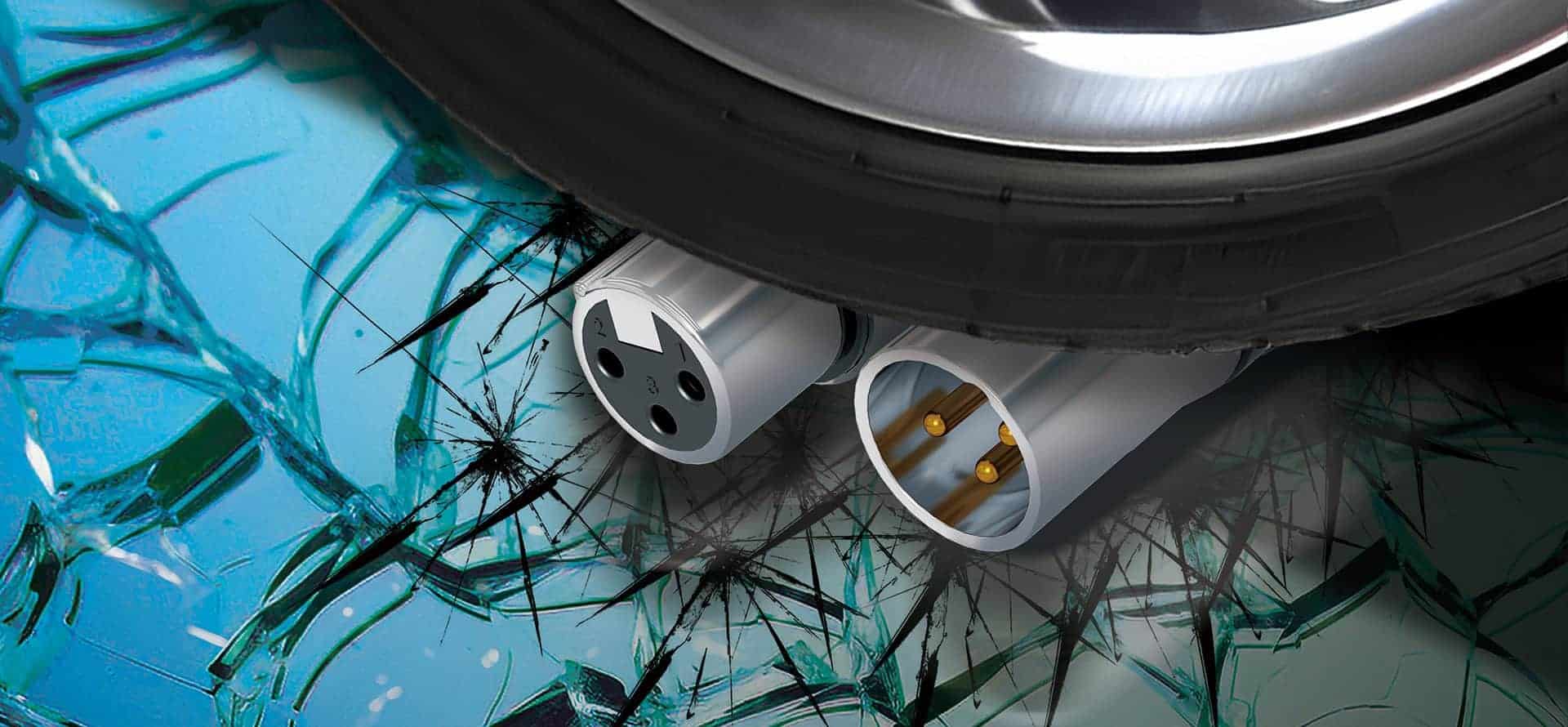
A bayonet connector pairs a male plug with radial pins to a female socket that captures and locks those pins after a short rotation, creating a reliable mechanical and electrical join. It delivers a fast, secure electrical or mechanical connection through a simple push-and-twist locking mechanism.
This post explains the bayonet coupling principle, explores different connector types (including the reverse bayonet), details their key features and benefits, and shows where they perform best.
What are Bayonet Connectors?
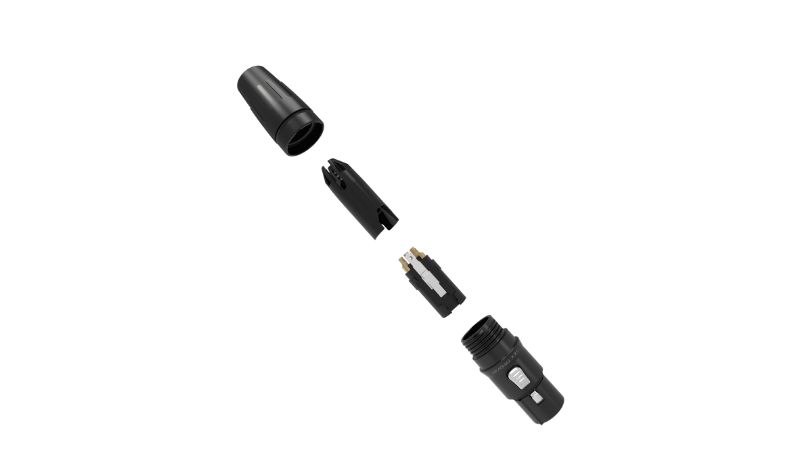
The bayonet mechanism uses a short rotation and matching features for fast, repeatable, and secure joins. This principle appears where quick mating, tactile feedback, and compact form factors are important.
Bayonet connectors are electrical or mechanical connectors that use bayonet coupling to lock mates quickly. Typical components include a male plug with one or more radial lugs and a female receptacle with matching L-shaped slots and retention springs. They are designed to provide hundreds or thousands of secure connections over their lifetime, making them a durable solution for demanding fields.
What is Bayonet Coupling and How it Works?
A bayonet coupling joins two cylindrical parts using radial pins on the male side that engage L-shaped slots in the female side. You push the parts together and then twist about 60–120 degrees; the pins travel along the slot’s ramp and settle into the locking notch.
The core of every bayonet connector is its coupling mechanism. It uses a short rotation—typically a quarter-turn—and matching mechanical features for fast, repeatable, and secure joins. This principle is chosen where speed, secure mating, and compact form factors are critical.
4 Types of Bayonet Connectors
Bayonet connectors use a push-and-twist lock for fast, repeatable mating and clear feedback. You’ll find versions for power and signal, RF/coaxial, or fiber-optic use.
Electrical Bayonet Connectors
These handle low- to medium-voltage power and multi-pin signal transmission. After the push-and-twist action, pins lock under a retaining ring. They are staples in machinery, industrial sensors, and medical devices where quick connection and vibration resistance are paramount.
Key electrical features:
- Contact arrangements: 2–12 pins for mixed power and signal.
- Ratings: current ratings from a few amps to tens of amps; voltages vary by design.
- Sealing: options include rubber gaskets or threaded collars for IP protection.
- Materials: brass or plated copper contacts; thermoplastic or metal shells.
RF Bayonet Connectors
RF variants like the ubiquitous BNC connector focus on maintaining controlled impedance (50Ω or 75Ω) for signals up to several GHz. The bayonet lock ensures stable contact between center conductors, minimizing signal reflection.
Important RF considerations:
- Types: BNC (0–4 GHz typical), and other bayonet-style coax plugs with varying frequency limits.
- Impedance: match 50 Ω for instrumentation or 75 Ω for broadcast/video.
- VSWR and insertion loss: choose precision versions for tighter RF specs.
- Mechanical: quick quarter-turn locking, often with visual and tactile engagement.
Fiber Optic Bayonet Connectors
These provide fast, keyed mating for optical fibers. A spring-loaded ceramic ferrule ensures precise alignment as the twist-lock mechanism is engaged, leading to low insertion loss.
Fiber-specific details:
- Ferrule: usually 2.5 mm ceramic ferrules for single or multimode fibers.
- Polishes: PC/UPC for general use, APC for return-loss-sensitive links.
- Performance: typical insertion loss ~0.2–0.5 dB, depending on polish and cleanliness.
- Durability: rated for thousands of mating cycles; dust caps recommended.
Reverse Bayonet Connectors
A critical variation is the reverse bayonet. It requires a counter-intuitive twist to unlock, making it highly resistant to accidental disconnection caused by incidental impacts or snags. This is essential in safety-critical or high-tamper environments.
Features & Benefits of Bayonet Connectors
Bayonet connectors give you quick, secure connections with minimal tools and clear feedback when mated. You benefit from fast operation, a positive locking action, and robust performance in repeated cycles and demanding environments.
Ease of Use and Safe Operation
The standardized locking action requires no tools, reducing assembly and maintenance time. The clear feedback—click, feel, and sometimes visual markers—prevents partially made connections, enhancing operational safety.
Rugged, Vibration-Resistant Design
The primary benefit is mechanical security. The locking mechanism resists axial pull and vibration, a necessity in aerospace, automotive, and industrial applications. The short mating cycle reduces wear compared to threaded alternatives, directly contributing to long-term durability. Many are designed with metal inserts in plastic housings for strength without excess weight.
Environmental Sealing and Robust Materials
To withstand harsh conditions, many bayonet connectors are sealed with O-rings or gaskets. High-performance series connectors, like some Binder’s or NCC Series 770 offerings, achieve ratings like IP67 protection even when unmated. Material choice is key:
- Brass: Cost-effective, good conductivity, often plated.
- Stainless Steel: For superior corrosion resistance in marine or chemical environments.
- Engineering Plastics (PEEK, etc.): Used in subminiature or lightweight cable and flange versions, offering excellent dielectric properties and chemical resistance.
Key Applications of Bayonet Connectors
Bayonet connectors are widely used wherever quick, secure mating and reliability under stress are non-negotiable.
Industrial Automation & Machinery
In factories, they are found on sensor arrays, modular machinery components, and control panels. Their versatility and speed minimize downtime during changeovers or maintenance. Durable seals allow them to perform in dirty or wet industrial environments.
Medical & Life Sciences Equipment
Medical devices utilize them for quick-change probes, monitoring leads, and portable diagnostics. Keyed designs prevent mis-mating, while materials and seals tolerate repeated sterilization cycles.
Aerospace, Defense, and Transportation
Here, performance is critical. Bayonet connectors are used in avionics, radio gear, and ground support equipment. They meet stringent specs for vibration, shock, and extreme temperatures, with designs often featuring secure bayonet locks with secondary retention and gold-plated contacts for faultless signal transmission.
The Future of Bayonet Connectors
Evolution continues toward smarter, more resilient designs. Trends include enhanced IP67 protection even when unmated as a baseline, further miniaturization, and the integration of embedded sensors for connection monitoring. The drive for standardized locking across industries will improve interoperability and reduce errors.
Experience Unrivaled Connection with Seetronic’s Bayonet Connectors
In today’s fast-paced world, compromised connections can lead to costly downtime and safety risks. Seetronic’s bayonet connectors offer a superior solution, combining the speed of a push-pull mechanism with the unwavering security of a threaded connection.
Discover Seetronic advantage today and explore our comprehensive range of bayonet connectors. Contact us to find the perfect solution for your next project!