A terminal block is a modular connector that secures two or more wires together, forming a secure, inspectable, modifiable, and disconnectable electrical connection. In electrical systems, direct wire splices are like permanently glued LEGO pieces—troublesome to adjust. Terminal blocks are the modular, reusable fix: the electrical equivalent of standardized LEGO bricks.
This post covers their core components, common types, advantages over direct wiring, applications, selection tips, and future trends to help you pick the right fit for your project.
Components of a Terminal Block & How They Work Together
Regardless of type, most terminal blocks share three core components that determine their safety, performance, and lifespan.
The Insulating Housing: Your First Line of Defense
This plastic body, commonly made from polyamide (PA66), polyester (PBT), or polycarbonate (PC), serves as the outer shell.
- Function: It ensures electrical insulation between terminals, offers mechanical protection, and safeguards users from accidental contact.
- Key Details: Look for material certifications (e.g., UL94 V-0 flame retardancy) and a defined operating temperature range. Housing design also determines the IP rating for environmental protection and includes mounting options such as DIN rail terminal blocks or panel-mount fixtures.
The Current-Carrying Core: The Conductive Highway
This is the internal metal part that actually carries the current from one wire to another.
- Materials: Usually made from copper, brass, or a copper alloy, and often plated with tin, nickel, or silver to enhance conductivity and prevent corrosion.
- Function: It’s the electrical bridge within the block. Its size, material, and design directly determine the block’s current and voltage rating.
The Securing Mechanism: The Heart of Reliability
This component defines the terminal type—screw, spring, or push-in—and is critical for long-term integrity.
- Principle: It must apply and maintain sufficient contact force for a stable, low-resistance joint while preventing wire pull-out.
- Critical Specs: Follow the manufacturer’s torque specifications for screw types and use only compatible wire gauges and types. Incorrect installation is a common cause of failure.
Common Types of Terminal Block
Choosing the right type is your first and most crucial decision. Each type offers a different balance of reliability, installation speed, and maintenance ease.
Screw-Clamp Terminal Blocks
- How They Work: A threaded screw is turned down to press a metal plate or the screw itself directly against the inserted wire, creating a powerful mechanical clamp and electrical connection.
- Best For: Universal applications, especially where high clamping force is needed, or connections might be frequently modified. They are highly versatile.
- Considerations: Screws can loosen over time due to vibration or thermal cycling, requiring periodic re-tightening. Installation is slower than other methods.
Spring-Clamp Terminal Blocks
- How They Work: A pre-tensioned, conductive spring inside the block exerts constant pressure on the inserted wire. A lever or actuator is used to open the spring for insertion.
- Best For: Environments with vibration or frequent temperature changes (e.g., machinery, vehicles). The spring maintains constant force, preventing loose connections.
- Considerations: Generally more tool-friendly and faster to install than screw types. Excellent for solid-core or ferruled stranded wires.
Push-In Terminal Blocks
Insert prepared solid/ferruled wires directly into ports (an internal spring clamp grips securely). Best for high-speed, high-volume installs (e.g., residential control panels, lighting systems)—fast, but less suited for fine-stranded wire (needs a ferrule; wire release requires a small tool).
Barrier Strips & PCB Mount Terminals
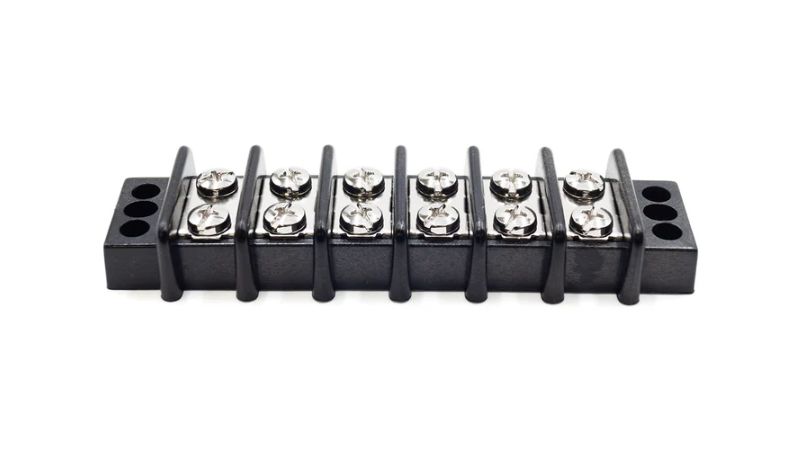
- Barrier Strips: Feature raised walls between connections for superior physical isolation (prevents short circuits). Common in high-voltage/industrial power distribution panels
- PCB Mount Terminals: Soldered directly to printed circuit boards (PCBs), linking boards to external wires; available in all clamping styles (screw, spring-loaded, push-in).
Advantages Of Using Terminal Blocks
Terminal blocks make wiring neater, safer, and easier to change. They let you manage connections by channel, isolate circuits, and swap components without disturbing adjacent wiring.
Organization & Maintenance
They group circuits in rows (ease of tracing signal/power paths) and support labeling/color-coded markers (speeds troubleshooting). Mounted on DIN rail terminal blocks, they let you rearrange modules or remove single blocks (no full harness pulls); removable bridges/feed-through designs split/combine circuits cleanly (servicing one device doesn’t disturb others).
Safety & Reliability
Secure clamping resists vibration better than splices. The insulated housing prevents accidental shorts, and many blocks meet international safety standards. Sharp blades inside the terminal are sometimes used in insulation displacement types for fast, reliable terminations without stripping.
Flexibility & Scalability
Add/remove/reroute circuits via extra blocks or jumper bridges (panels adapt to system growth). Mix functions (feed-through, fuse terminal blocks) on the same DIN rail; they accept diverse wire sizes and connection methods (screw, spring-loaded, push-in) for standardized setups (simplifies upgrades/integration).
Cost-Effectiveness
Circuits can be expanded or reconfigured using jumper bridges or additional blocks. Different functions (feed-through, fuse, thermocouple blocks) can be mixed on the same rail. They accommodate various wire sizes and connection methods.
Applications Of Terminal Blocks
Terminal blocks organize wiring, provide secure electrical connections, and simplify maintenance across many systems. You’ll find them where reliable distribution, easy testing, or frequent wiring changes are required.
Industrial Automation & PLC Systems
In control cabinets/PLC racks, they interface field devices and controllers: feed-through/distribution blocks route sensor/actuator/I/O signals to PLC modules. Spring-loaded/screw terminal blocks secure conductors (spring types reduce re-torquing in vibration-prone setups); blocks with test points/fuse holders isolate circuits (diagnostics without disconnecting field wiring). Modular DIN rail mounting speeds assembly/rearrangement (add I/O/replace modules without full rewiring).
Power Distribution & Switchgear
In power panels, they handle bus connections, branch circuits, and ground terminal block setups. Barrier terminals suit high-current/voltage needs (clear phase separation); combined power/ground terminals centralize earthing. Fuse terminal blocks protect downstream circuits (fuses accessible for fast service); color-coded insulation/markers speed phase/neutral identification.
Renewable Energy Systems
Solar/wind/battery setups use durable connections blocks: PV-rated terminals manage high DC voltages (string combiners/inverter inputs); heavy-duty blocks handle power distribution (easy balancing/monitoring/disconnects). Surge-protected/insulated blocks reduce fire/arc risks; pluggable/fused variants isolate strings/inverters (maintenance without system disruption).
Telecommunications & Data Networks
In comms rooms/closets, they organize copper/fiber-adjacent wiring (IDC/punch-down blocks for fast copper connections). Shielded terminals support grounding (reduces interference); modular, labeled blocks speed moves/adds/changes. Data centers use low-profile, high-density blocks (saves rack space; separates power/telemetry/network wiring).
Choosing The Right High-Quality Terminal Block
- Electrical Specs: Verify current/voltage rating (avoid overheating/insulation failure).
- Wire & Clamp Compatibility: Confirm wire sizes and clamp type (screw, spring-loaded, push-in) align with your conductors/maintenance needs.
- Mounting & Space: Pick DIN rail terminal block (space-saving, easy replacement), PCB, or panel mounting (fits your layout).
- Environment & Compliance: Select IP ratings, corrosion-resistant materials, and standards (IEC 60947-7-1, UL 1059) for vibration/temperature/moisture exposure.
- Layout: Use pole count/pitch/labeling (reduces clutter; eases troubleshooting).
Future Trends In Terminal Block Technology
- Miniaturization: Finer pitches (<3.5 mm), lower profiles, multi-level stacking (maximizes space on crowded PCBs).
- Tool-Free Terminations: Push-in/Push-X styles (faster installs, fewer wiring errors; simplifies maintenance).
- Smart Features: Sensing/diagnostics/IoT connectivity (monitor connection status/temperature/load for predictive maintenance).
- SMT Compatibility: Surface-mount versions (fits automated assembly workflows for denser production lines).
- Enhanced Safety: Higher-temperature materials, integrated fuseing/isolation (boosts reliability in harsh/safety-critical setups).
Terminal Block FAQ
How do I choose the right terminal block for my project?
Consider electrical specs (current/voltage), wire size compatibility, clamp type (screw, spring, push-in), and environmental factors like vibration or moisture.
What’s the difference between spring and screw clamp terminals?
Spring clamps maintain constant pressure, ideal for vibration. Screw clamps offer high force but may loosen over time. Spring types allow faster, tool-friendly installation.
Do I need a special tool for push-in terminal blocks?
For insertion: no, solid or ferruled wires push directly in. For removal: a small release tool is usually required to open the internal spring safely.
Can terminal blocks damage wires?
If improperly installed (e.g., wrong wire gauge, over-tightening screws), sharp edges or excess force can damage the wires. Always follow the manufacturer’s specifications.
What are DIN rail terminal blocks used for?
They allow modular, organized mounting inside electrical enclosures. Blocks snap onto a standard DIN rail for easy rearrangement, addition, or removal.