Quick Answer
Expanded beam fiber connectors send light across a small air gap between two lenses instead of joining fiber ends together directly. That non-contact design makes them far more tolerant of dust, dirt, and repeated mating cycles than standard physical-contact connectors like LC, SC, or MPO. The trade-off is cost and slightly higher signal loss. They’re the right choice for field, military, industrial, and outdoor deployments where connectors get mated and unmated often in dirty conditions — and usually overkill for a clean, controlled environment like a data center or office building.
What Is an Expanded Beam Fiber Connector?
Most fiber connectors work by physically pressing two polished fiber ends together so light can pass directly from one to the other. That’s how LC, SC, ST, and MPO connectors all work — it’s precise, low-loss, and cheap to manufacture, but it depends on those fiber end-faces staying perfectly clean. A single speck of dust on the contact point can block or scatter enough light to break the connection.
Expanded beam connectors solve that problem differently. Instead of touching, each connector has a small lens in front of the fiber end. One lens takes the narrow beam coming out of the fiber and widens it into a much larger, collimated beam of light — sometimes tens of times wider than the original fiber core. That wider beam crosses a small air gap to a second lens on the mating connector, which narrows it back down and refocuses it into the receiving fiber.
Because the connection point is no longer a delicate fiber tip but a much larger lens surface, dust and minor contamination have far less effect on signal quality. There’s also no physical wear between the fiber ends themselves, since they never touch.
Where Expanded Beam Connectors Are Actually Used
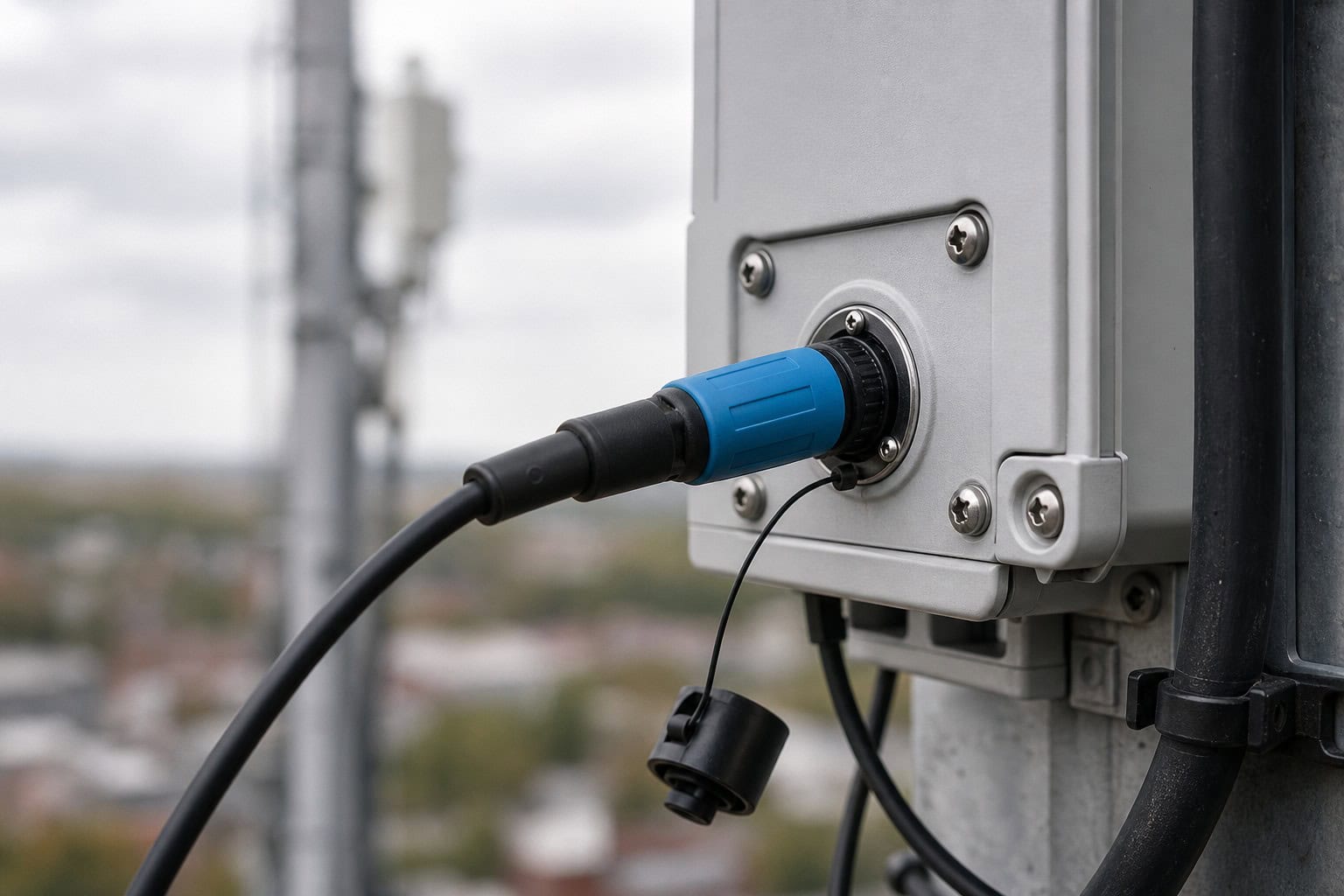
This isn’t a general-purpose connector type — it exists specifically to solve problems that only show up in demanding environments:
- Military and tactical field communications — connectors that need to be mated and unmated in the field, often by someone wearing gloves, in sand, mud, or extreme temperatures
- Mining and offshore operations — dusty, wet, or corrosive environments where standard connectors would need constant cleaning
- Outside broadcast — equipment set up and torn down repeatedly at different outdoor locations
- Industrial and factory automation — machinery environments with airborne particulates or vibration
- Medical equipment — devices that get connected and disconnected thousands of times and need to tolerate fluids and sterilization routines
If your project doesn’t involve any of the above — for example, a standard indoor data center, office network, or telecom rack — a conventional physical-contact connector will almost always be the more practical and cost-effective choice.
Expanded Beam vs. Physical Contact Fiber: Quick Comparison
| Physical Contact (LC, SC, MPO) | Expanded Beam | |
|---|---|---|
| Connection method | Fiber ends touch directly | Light crosses an air gap between lenses |
| Sensitivity to dust/dirt | High — a dirty end-face can block the signal | Low — designed to tolerate contamination |
| Mating cycle durability | Lower — repeated contact wears the fiber tip | Higher — no physical wear between fibers |
| Signal loss | Lower, more predictable | Slightly higher due to the lens interface |
| Cost | Lower | Higher, due to precision lens components |
| Typical setting | Data centers, telecom, indoor networks | Military, industrial, outdoor, field-deployed systems |
Standards Worth Knowing
If you’re sourcing expanded beam connectors for a defense, aerospace, or industrial project, two standards come up regularly and are worth asking your supplier about directly:
- MIL-DTL-83526 — a U.S. military specification covering expanded beam connectors for rugged, field-deployable fiber optic systems
- NATO STANAG 4290 — a NATO standardization agreement that some tactical expanded beam connectors are qualified against
Neither standard is required for every application, but if your end use is defense-related or your project spec calls out either one by name, confirm your supplier’s part actually meets it rather than just describing itself as “military-grade.”
Matching the Connector to the Application
Whether expanded beam is the right fit for a project comes down to deployment conditions, not personal preference. A few factors engineering and procurement teams typically weigh when specifying a connector:
- Mating frequency and field conditions. Connectors that are mated and unmated repeatedly outside a controlled environment place more stress on the connection point, which favors expanded beam’s tolerance to dust and debris.
- Contamination risk at the connection point. Deployments exposed to dust, moisture, or particulate matter benefit from a non-contact interface that isn’t degraded by surface contamination.
- Compliance requirements. If a project specification references a military or tactical standard, expanded beam is often a requirement of the spec rather than an optional upgrade.
- Deployment environment. Controlled indoor environments with infrequent reconnection are typically well served by standard physical-contact connectors — see our guide on single-mode vs multimode fiber for that comparison.
Many projects fall somewhere between these extremes — outdoor but not military-spec, or industrial but only occasionally re-mated. In these cases, the right choice usually comes down to weighing long-term maintenance costs against the higher upfront investment in expanded beam hardware, which is where an experienced connector partner can help narrow down the right configuration for the application.
What to Ask Your Supplier When Sourcing
Because expanded beam connectors are precision optical components, build quality and consistency matter more here than with most connector types:
- Fiber count and mode support. Confirm whether you need single-mode or multimode fiber, and how many channels the connector supports — most expanded beam connectors are available from 2 up to around 16 fibers.
- Housing material and sealing. Look for hardened, corrosion-resistant housings with proper sealing if the connector will be exposed to moisture or extreme temperatures.
- Mating cycle rating. Ask how many mate/de-mate cycles the connector is rated for before performance degrades — this varies significantly between manufacturers.
- Field terminability. Some expanded beam connectors can only be factory-terminated, while others can be terminated or repaired in the field. Confirm which one you’re getting before you commit to a deployment plan.
- Standards compliance documentation. If your project requires MIL-DTL-83526 or STANAG 4290 compliance, ask for documentation, not just a product description that mentions the standard.
Work With a Manufacturer That Understands Optical Fiber
Expanded beam connectors typically end up in the least forgiving parts of a system — field deployments, defense programs, offshore installations — where a failed connection is hard to reach and expensive to fix once it’s in service. Getting the specification right before production matters more here than with most connector types.
Seetronic supports project teams at every stage, from confirming which configuration fits the application to producing standard or custom-engineered parts at volume. If you’re specifying expanded beam, MPO, or LC fiber connectors for a demanding deployment, our engineering team can help evaluate the right fit before you commit to a design.
The same due-diligence questions apply to any ruggedized connector program — see our guide to evaluating a connector manufacturer for a fuller sourcing checklist. Browse the Optical Fiber product range or reach out to our team to talk through your project.
FAQ
Are expanded beam connectors compatible with standard fiber connectors like LC or SC? No. Expanded beam connectors use a different mating interface built around lenses rather than direct fiber contact, so they aren’t physically or optically compatible with standard physical-contact connectors. Any transition between the two requires a converter or a separately terminated cable run.
Do expanded beam connectors have higher signal loss than physical contact connectors? Generally yes, by a small margin. The lens interface introduces slightly more insertion loss than a clean, direct physical contact connection. For most harsh-environment use cases, that trade-off is worth it because physical contact connectors lose far more performance once contamination or wear sets in.
Can expanded beam connectors be used indoors in a normal data center? They can, but there’s usually no reason to. Their advantages — dust tolerance and high mating-cycle durability — matter most in environments physical contact connectors struggle with. In a clean, controlled data center, a standard connector will cost less and perform just as reliably.