What Are XLR and RCA Connectors?
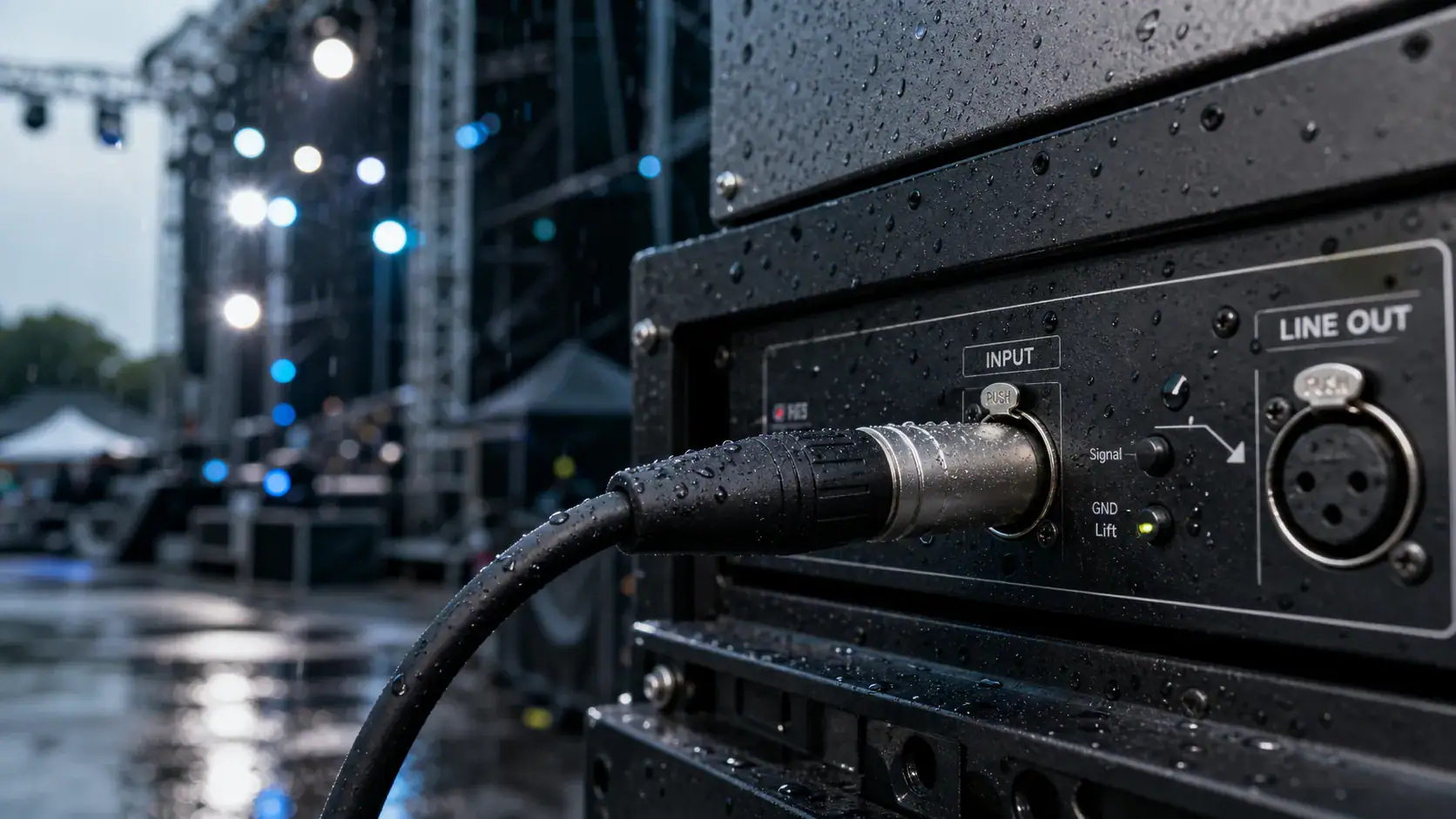
XLR is a round, 3-pin connector with a locking clip. It’s mainly found on professional audio gear — microphones, mixers, amplifiers, and stage equipment. It’s built to carry a balanced signal, which is why it holds up well over long cable runs or in noisy environments.
RCA (sometimes called a phono plug) is a simpler two-pin connector, usually seen on consumer and home audio gear — TVs, receivers, subwoofers, turntables, and speakers. It carries an unbalanced signal, which is fine for shorter cable runs but more likely to pick up noise over longer distances.
Since one carries a balanced signal on three pins and the other carries an unbalanced signal on two, they can’t plug into each other directly — that’s what an adapter is for.
Why You’d Need an XLR to RCA Adapter
Most professional audio equipment — mixers, audio interfaces, DI boxes, DACs — sends output on balanced XLR connectors. A lot of the equipment on the receiving end, especially home audio gear, doesn’t have XLR inputs at all. Powered speakers, home theater receivers, subwoofers, and older hi-fi components typically only accept RCA.
This mismatch shows up constantly in a few recurring setups:
- A studio monitor with only RCA inputs being driven by a mixer’s balanced XLR output
- A DJ controller or audio interface with XLR outs feeding a home stereo system
- A broadcast or install project where legacy RCA-terminated equipment needs to connect into a newer XLR-based signal chain
In all of these cases, an XLR to RCA adapter is the fastest fix — no rewiring, no custom cable order, just a drop-in connector.
XLR to RCA Wiring Diagram: The Standard Pin Connection
A standard 3-pin XLR connector carries a balanced signal across three conductors:
| XLR Pin | Function |
|---|---|
| Pin 1 | Ground / shield |
| Pin 2 | Hot (+) — non-inverted signal |
| Pin 3 | Cold (−) — inverted signal |
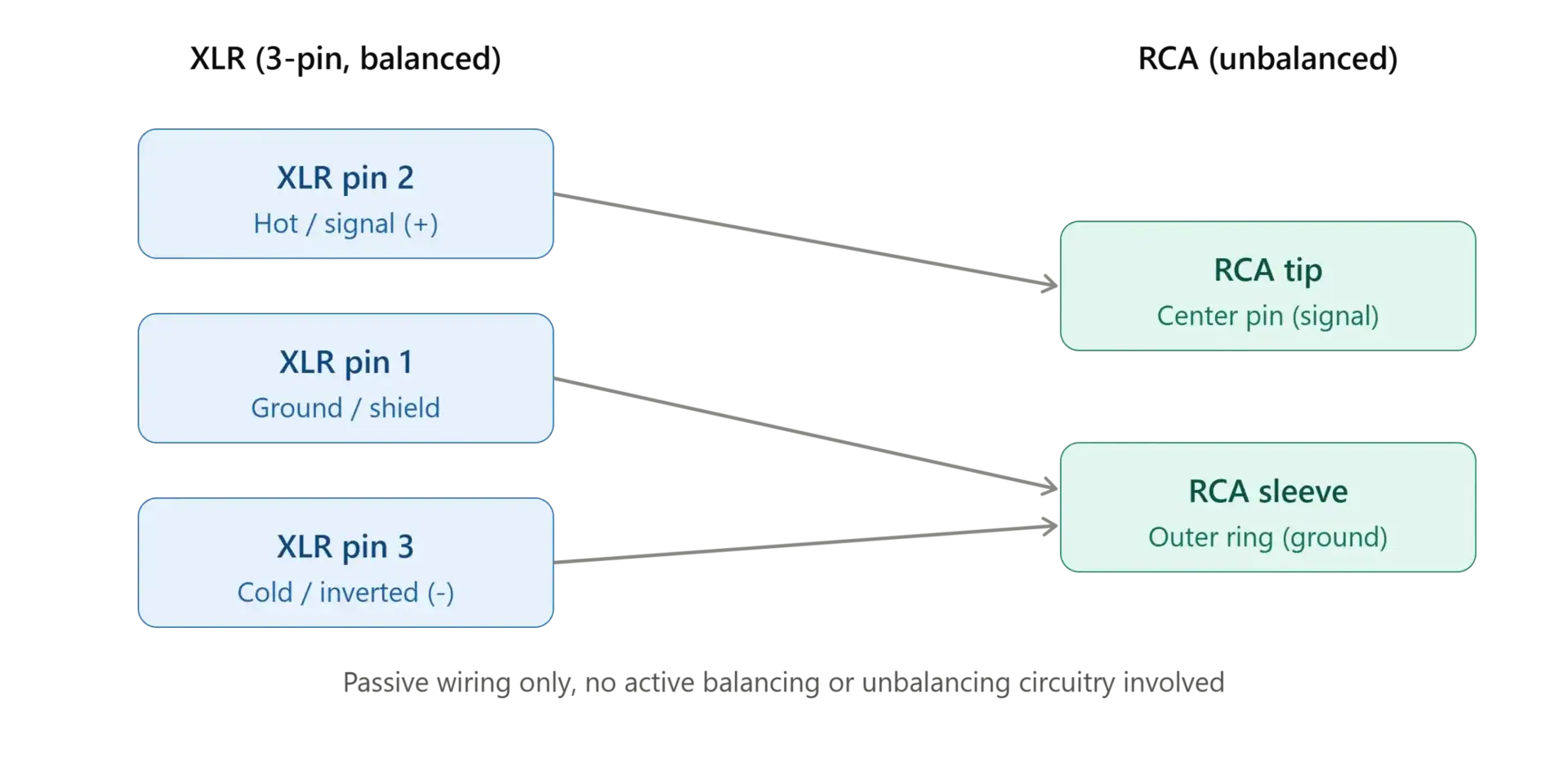
An RCA connector only has two conductors — a center pin (signal) and a sleeve (ground) — because it was designed for unbalanced audio. To make the two compatible, the adapter wiring collapses the three XLR conductors down to two:
- XLR Pin 2 (hot) connects to the RCA center pin (tip)
- XLR Pin 1 (ground) and Pin 3 (cold) connect together to the RCA sleeve (ground)
This is the wiring convention used in nearly all off-the-shelf XLR to RCA adapters and cables. It’s a purely passive connection — there’s no active circuitry converting the balanced signal into a true unbalanced one, which is why the “balanced” benefit of noise rejection is lost once you go through this adapter (more on that below).
Male-to-Male vs Male-to-Female: Which One Do You Need
Once you understand the pin wiring, the next decision is simpler than it looks — it just comes down to what’s already on your gear.
| XLR Male → RCA Male | XLR Male → RCA Female | |
|---|---|---|
| Typical use case | Connecting to a device with a female RCA jack via a barrel-style coupler, or building a custom patch panel | Plugging directly into a standard RCA input on a receiver, amp, or powered speaker |
| Signal direction | Output side, mates with female RCA jacks or another male-to-female adapter | Output side, accepts a standard male RCA cable on the other end |
| How common it is | Less common — mostly panel-mount, rack integration, or OEM/custom builds | Most common — covers the vast majority of home and studio hookups |
| Seetronic equivalent | MA3MRM (3-pin XLR Male to RCA Male) | MA3MRF (3-pin XLR Male to RCA Female) |
A simple way to decide: look at the RCA-side connector on the device or cable you’re trying to mate with. If it has a male RCA plug already (like the end of a standard RCA cable), you need the female version so the two plugs can connect. If the device itself only has a bare RCA jack (socket) built into the chassis, you need the male version to plug directly into it.
Common Wiring Mistakes to Avoid
Because this is a passive, wiring-only adapter, most of the problems people run into aren’t about the adapter failing — they’re about what happens electrically once you bypass the balanced connection.
- Losing noise rejection. Balanced XLR cabling cancels interference because it carries two inverted copies of the same signal. Once you convert to RCA, that cancellation is gone, so keep RCA cable runs as short as possible after the adapter to minimize hum and noise pickup.
- Grounding pin 3 incorrectly. Some cheaper adapters short pin 3 directly to ground at the XLR end rather than at the RCA end. On most modern gear this causes no damage, but it can add unnecessary stress to the output circuitry on some preamps and processors. If you’re specifying adapters for a project, ask your supplier which pin 3 termination method they use.
- Assuming the adapter “balances” the signal. An XLR to RCA adapter does not add balancing or unbalancing circuitry — it’s a passive pin re-router. If you need true impedance-matched conversion (for long cable runs or noisy environments), a powered balanced-to-unbalanced converter box is the correct tool, not a passive adapter.
What to Check When Sourcing XLR to RCA Adapters in Bulk
If you’re specifying these adapters for an AV integration project, a rental fleet, or a private-label product line, the wiring is only half the story — build quality determines whether they hold up under repeated use. A few things worth checking with your supplier:
- Shell material. Metal-bodied adapters (zinc alloy or brass) hold up far better under repeated plugging, panel mounting, and mechanical stress than plastic-bodied versions. Plastic can be acceptable for low-frequency, low-stress consumer use, but for install or rental work, metal is the safer default.
- Contact plating. Gold-plated contacts resist oxidation and maintain consistent conductivity over years of use — important for signal integrity in fixed installs where the adapter isn’t disconnected often.
- Pin 3 termination method. As noted above, ask whether pin 3 is grounded or left floating, and make sure it matches what your downstream equipment expects.
- Consistency across batches. For bulk orders, confirm the manufacturer tests continuity and polarity on every unit, not just a sample batch — a single reversed pin in a batch of adapters is a common (and hard-to-diagnose) field complaint.
- Customization options. If you’re building this into a private-label product or need a specific housing color, print, or connector combination, check whether the manufacturer supports OEM customization at your order volume.
FAQ
Does an XLR to RCA adapter reduce sound quality?
Not on its own, but it does remove the noise-cancellation benefit of the balanced XLR connection. On short runs (a few feet), the difference is usually inaudible. On long runs, especially near power cables or other interference sources, you may notice more hum or noise than you would with a fully balanced connection.
Can I use an XLR to RCA adapter for a microphone?
Technically it will physically connect, but it’s not recommended. Microphones rely on phantom power and balanced wiring for clean signal at low levels — running a mic through an unbalanced RCA path usually introduces noticeable noise and loses the benefit of the balanced circuit.
Is XLR Male to RCA Female the same as an XLR to RCA cable?
No. An adapter is a rigid, short connector meant to join two existing cables or a cable to a device. A cable has XLR and RCA connectors on opposite ends of a length of wire. Adapters are typically used when you already have cables on both sides and just need to bridge the connector types.
Seetronic manufactures both configurations covered in this guide — MA3MRM (XLR Male to RCA Male) and MA3MRF (XLR Male to RCA Female) — with metal housings and gold-plated contacts for reliable, long-term use in both installed and portable audio systems. Browse the full Adapters product line, or get in touch for OEM and bulk sourcing options.