Choosing the right connector affects your entire system. It impacts speed, reliability, distance, and cost. Two of the most common choices are fiber optic connectors and RJ45 connectors. Both transmit data. But they work differently and serve different needs.
This guide breaks down the differences. It helps you choose the right connector for your application.
What Is an RJ45 Connector?
An RJ45 connector is a standard plug used in Ethernet networks. It uses copper wires to transmit electrical signals. Most office networks, AV control systems, and building automation systems use RJ45.
RJ45 connectors are easy to install. They are cost-effective and widely compatible. You can find them in almost every networking device.
At Seetronic, our RJ45 connectors are built for professional environments. They support applications in stage lighting control, broadcast, and industrial network communication. Each connector is engineered for consistent performance and long service life.
What Is a Fiber Optic Connector?
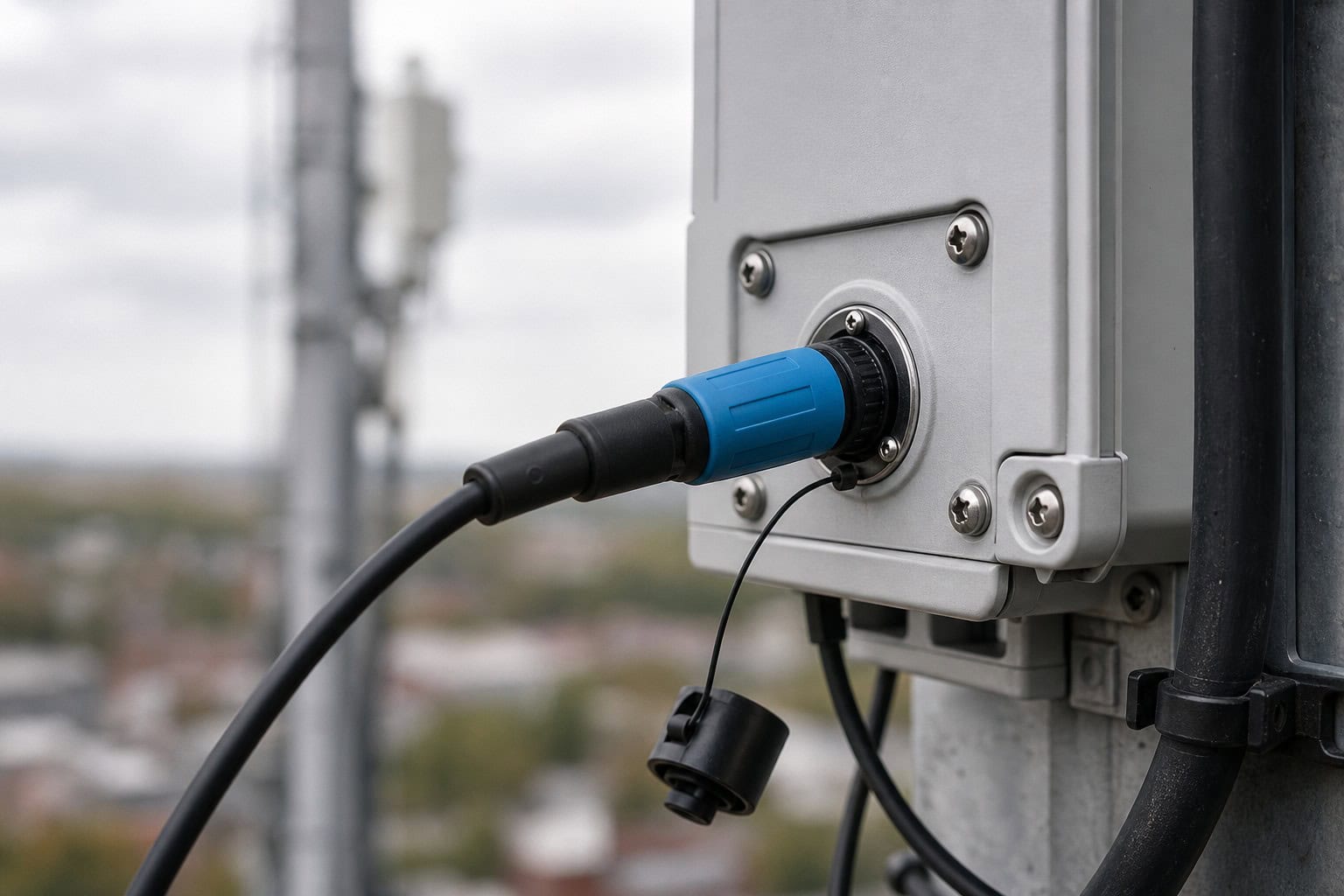
A fiber optic connector transmits data using light, not electricity. It uses glass or plastic fiber as the signal path. Light pulses carry data at extremely high speed over long distances.
Fiber optic connectors are immune to electromagnetic interference (EMI). They support much higher bandwidth than copper. They are the preferred choice in broadcast facilities, large venues, and data centers.
Key Differences at a Glance
The table below compares the two connector types across the most important performance factors.
| Feature | Fiber Optic Connector | RJ45 Connector |
|---|---|---|
| Signal Type | Light (optical) | Electrical (copper) |
| Maximum Distance | Up to 100 km+ | Up to 100 m (Cat6) |
| Bandwidth | Very high (100 Gbps+) | Up to 10 Gbps (Cat6a) |
| EMI Immunity | Yes — fully immune | No — susceptible to EMI |
| Latency | Extremely low | Low |
| Installation Complexity | Moderate to high | Easy |
| Cost | Higher | Lower |
| Weight | Lighter | Heavier |
| Typical Use Cases | Broadcast, data centers, large venues | Office networks, AV control, stage systems |
When to Choose an RJ45 Connector
RJ45 is the right choice in many professional environments. Here are the most common scenarios.
Short to medium cable runs. RJ45 supports distances up to 100 meters per segment. This is enough for most stage, studio, and building installations.
Budget-sensitive projects. RJ45 infrastructure costs less than fiber. Cables, switches, and patch panels are widely available at lower prices.
Easy field installation. RJ45 connectors are simple to terminate on-site. No special splicing equipment is needed. This reduces labor time and cost.
Standard network integration. Most network switches and control equipment use RJ45 ports. Compatibility is rarely an issue.
Lighting and AV control. Stage lighting systems, DMX-over-IP networks, and AV distribution systems commonly use RJ45 for short-range data links.
Seetronic RJ45 connectors are designed for these demanding environments. They meet the rigorous requirements of professional audio, video, and lighting applications.
When to Choose a Fiber Optic Connector
Fiber optic connectors become the better choice when your requirements go beyond what copper can deliver.
Long cable runs. Fiber can carry signals over kilometers without signal loss. This makes it ideal for large stadiums, broadcast facilities, and outdoor events.
High-interference environments. Stage environments use powerful motors, dimmers, and wireless equipment. These generate EMI. Fiber is completely immune to electrical interference.
High-bandwidth applications. 4K and 8K video, multi-channel audio, and live broadcast streaming demand high data throughput. Fiber handles these loads without bottlenecks.
Secure data transmission. Fiber signals are harder to intercept than copper signals. This matters in broadcast and military applications.
Future-proofing. If your infrastructure needs to scale, fiber provides headroom for bandwidth growth over many years.
Side-by-Side Application Guide
This table maps each connector type to common professional use cases to help you decide faster.
| Application | RJ45 Connector | Fiber Optic Connector |
|---|---|---|
| Stage lighting control | ✅ Recommended | ✅ For large venues |
| Studio AV distribution | ✅ Recommended | ✅ For high bandwidth |
| Broadcast signal transport | ⚠️ Short runs only | ✅ Recommended |
| Live concert networking | ✅ For local links | ✅ For long runs |
| Industrial automation | ✅ Recommended | ✅ For EMI-heavy zones |
| Building & campus networks | ✅ Floor-level links | ✅ Inter-building links |
| Data center interconnects | ⚠️ Limited distance | ✅ Recommended |
| Outdoor/touring events | ⚠️ With protection | ✅ Recommended |
Can You Use Both?
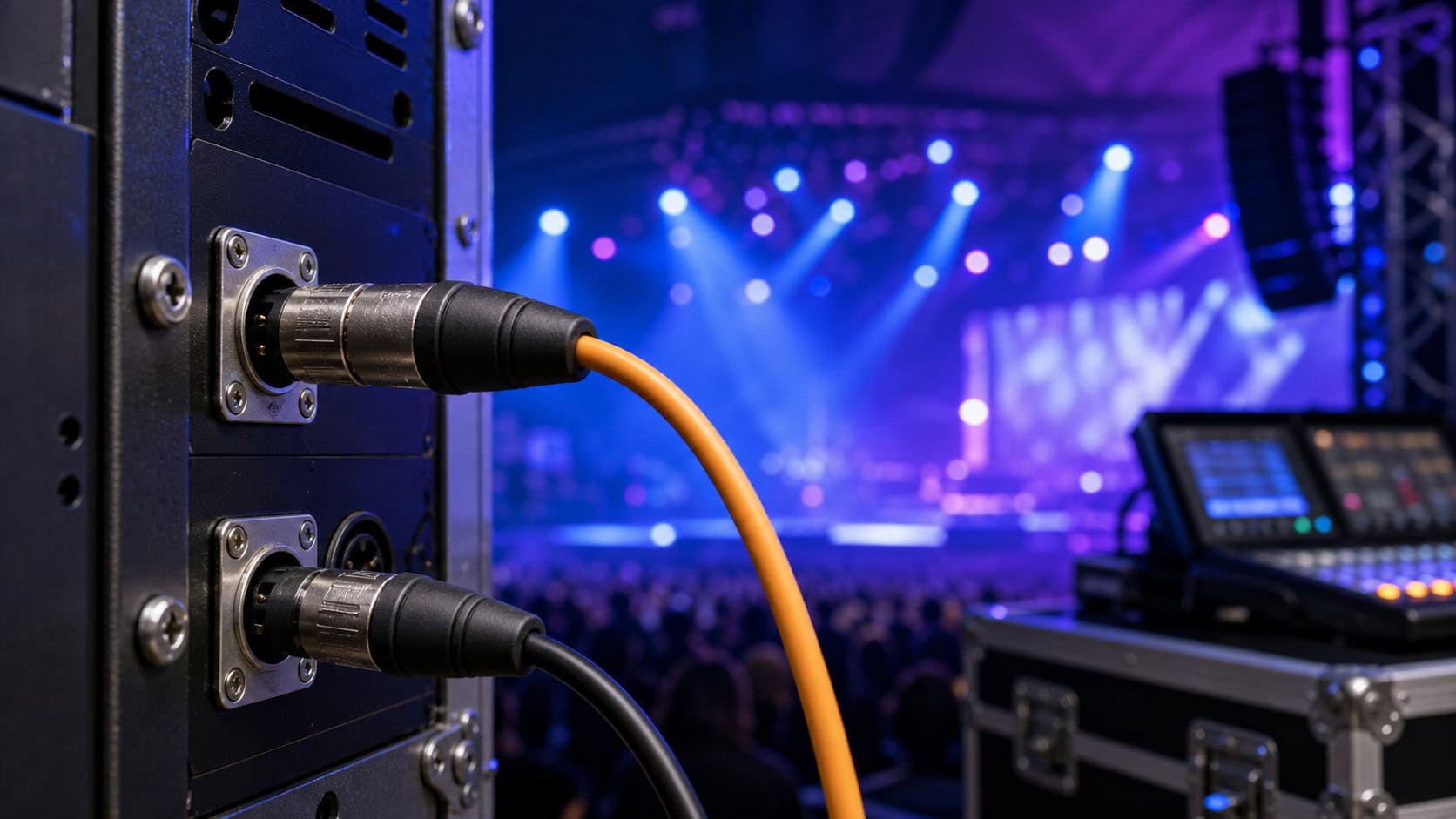
Yes. Many professional systems use both connector types together. A typical broadcast or live event setup uses fiber for the main signal backbone. It then uses RJ45 for local device connections and control links.
This hybrid approach gives you the best of both technologies. Fiber handles the long-distance, high-bandwidth runs. RJ45 handles the last-mile device connections where simplicity and cost matter.
What to Look for in a Quality Connector
Whether you choose fiber or RJ45, connector quality matters. A poor-quality connector causes signal loss, intermittent faults, and early failure.
Look for these features:
-
Gold-plated contacts — reduce oxidation and maintain stable conductivity
-
Robust housing — withstands repeated plug cycles and mechanical stress
-
Precise tolerances — ensure consistent mating and reliable signal transfer
-
Environmental protection — IP-rated designs resist dust and moisture
-
Tested performance — connectors should pass electrical, mechanical, and environmental testing
At Seetronic, every connector goes through strict quality control. Our manufacturing process covers material selection, precision machining, surface plating, assembly, and final testing. This ensures stable performance in demanding professional environments.
Which Connector Should You Choose?
RJ45 connectors are the practical choice for most professional audio, video, and lighting applications. They are affordable, easy to use, and widely compatible.
Fiber optic connectors are the better choice when distance, bandwidth, or interference are limiting factors. They deliver superior performance in large-scale and high-demand environments.
In many cases, the best solution uses both. Match the connector type to the specific requirements of each part of your system. That is how professional installers get reliable results every time.
For professional-grade RJ45 and fiber-compatible connectors built for stage, broadcast, and industrial applications, visit Seetronic.
Frequently Asked Questions
Can RJ45 replace fiber optic in a broadcast setup?
Not in most cases. RJ45 works well for short runs. But fiber is required for distances over 100 meters and for high-bandwidth broadcast signal transport.
Is fiber optic harder to maintain than RJ45?
Fiber requires cleaner handling and careful connector care to prevent contamination. RJ45 is easier to maintain in the field. However, both types perform reliably when installed correctly.
Which connector type is more durable?
Both can be highly durable. Durability depends on build quality, not connector type. A well-engineered RJ45 connector outlasts a poorly made fiber connector.
Does Seetronic offer both types?
Yes. Seetronic manufactures professional-grade RJ45 connectors for a wide range of applications. Visit seetronic.com to explore the full product range.